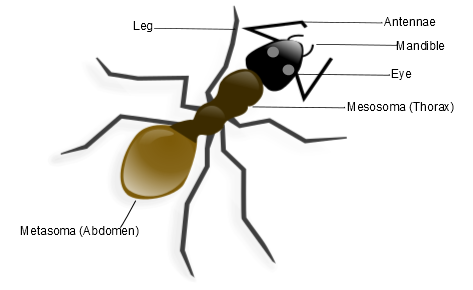
| The first thing you will notice in this diagram of an ant's anatomy
is the three main divisions. The head, the trunk, and the
metasoma. Ant bodies, like other insects have an exoskeleton
. Their skeleton is on the outside - not covered by skin, muscles,
and tissue like humans. |
| The head of an ant has several imporatant parts. First the
eyes. Ant eyes are a lot like flies. They have many small eyes
connected together. This enables ants to see movement very well. |
| Also Attached to the head of the ant are two feelers. The
feelers are special organs of smell that help ants communicate. If you
have every seen an ant find a food source, it is not long before the
ant communicates to his friends and their are many ants there. Ants
release pheromones (chemicals that have different smells) to
communicate with each other. The feelers pick up these smells as
signals. |
| The head also has two strong pinchers which are used to carry food,
to dig, and to defend. Just inside the mouth is a small pocket where
ants can store food. They can give this food to other ants in need.
|
| The trunk of the ant is where all 6 legs are attached. At the
end of each leg is a sharp claw that helps ants climb and hang onto
things. |
| The metasoma of the ant is a poison sack. Ants are closely
related to wasps and other stinging insects. Many types of ants have
stingers and can inflict a very painful sting. This is a useful way to
defend against the many predators ants have. |
| Inside Ants do not have lungs. Oxygen enters through tiny
holes all over the body and Carbon Dioxide leaves through the same
holes. There are no blood vessels. The heart is a long tube
that pumps colorless blood from the head back to the rear and then back
up to the head again. The blood kind of coats the insides of the ants
and is then sucked into the tube and pumped up to the head again. The
nervous system of ants consists of a long nerve cord that also
runs from head to rear with branches leading to the parts of the body,
kind of like a human spinal cord. |